Budget Testimony: Need For DD Raises Critical, Stable Services Demand Double Current Funding

tom Kane                         RI capitol tv Image

tom Kane                         RI capitol tv Image

By Gina Macris 

This article has been updated. 

As others had done before him, Tom Kane told members of the House Finance Committee that he “could not stress enough” the importance of the General Assembly approving an additional $6.1 million to lift the poverty-level pay of some 4,000 front-line employees of private agencies under contract with the state to care for adults with developmental disabilities.  

At the same time, Kane, CEO of AccessPoint RI, one of those private agencies, said in a hearing April 11 that the overall funding for developmental disabilities is only about 50 percent of what is needed for service providers to regain the financial stability they once had and help their clients receive the supports they need and deserve. 

All together Governor Gina Raimondo seeks General Assembly approval for raising the currently enacted developmental disability budget of $246.2 million by $10.5 million over the next 14 months, with $4.4 million of the increase applied before June 30. Another $6.1 million would be added for the fiscal year beginning July 1, for a total of $256.7 in the fiscal year ending June 30, 2018.

Kane explained to members of the Finance Committee’s Human Services Subcommittee, led by Rep. Teresa A. Tanzi, D-South Kingstown and Narragansett), the different kinds of pitfalls he saw in Raimondo’s attempts to offset the cost of the raises by cutting expenses in other areas – or not covering some necessary spending at all.  

For example, Kane said, AccessPoint had a $107,000 increase in health insurance rates this year. ”There is no money” to cover that cost, he said. “We spend almost $1.2 million in health insurance for 158 people,” he said.  Kane said he could not expect his employees, many of whom make less than $11 an hour, to contribute more to health insurance, so other adjustments were made. He did not elaborate. 

“But at some point there’s going to be a collision between all these additional costs” and direct care workers, Kane said. In written remarks, he said the “cost of other insurances, building maintenance, rent, vehicles, fuel and office supplies continue to increase, adding to the financial strain on organizations. These costs should not be seen as extraneous. They directly relate to our ability to focus our full attention on good quality service provision,” Kane said.

He also zeroed in on some line-item savings that Raimondo has budgeted to offset the cost of the second consecutive raise for direct care workers, particularly the plan to reduce group home costs by $2.1 million in state funds. That ongoing effort, driven by economic and policy considerations, aims to move group home residents to less costly shared living arrangements in private homes - a process that requires clients to actively agree to the change. 

During the transition, there must be a consideration for maintaining the living arrangements of the individuals left behind in the group homes, Kane said, recalling a case in which two of four people in one AccessPoint home opted for shared living. Because the agency could not afford to keep the house operating with only two residents, it sought supplemental funds from the Division of Developmental Disabilities for a few months to cover outstanding expenses while it figured out its long-range plan, Kane said. The home finally closed, he said.

The example illustrates how, during a transition, “you are balancing two systems at the same time, “ Kane said.

“If you don’t pay attention to the current system with the same amount of zeal as the new system, people will get lost,” he said.

In fact, the state so far has been unable to realize much savings from the emphasis on shared living, only $100,000 of a target of $2.6 million in state funds in the current fiscal year, according to officials of the Department of Behavioral Healthcare, Developmental Disabilities and Hospitals (BHDDH).

Since last July, a total of 48 group home residents have committed to shared living. That figure is 18 shy of a target of 66 individuals for the fiscal year ending June 30.

Kerri Zanchi, Director of the Division of Developmental Disabilities, said that of the 48, 28 have moved since December, when the division began addressing issues that were barriers to shared living arrangements, like a need for physical modifications to some houses to make them more easily accessible, as well as extra medical and behavioral supports needed in the host homes. She said the division is also considering a range of other alternatives to group home living.

Ultimately, Kane said, a budget is a “representation of the values of our state.”  The care for people with disabilities and the salaries paid to caregivers either will reflect the dignity and respect afforded valuable members of society, or they won’t, Kane said.

 “I understand you have a lot of very difficult decisions to make,” he told the legislators, “and the numbers (revenues) aren’t looking great this year, which are going to make all those decisions even tougher.”

But Kane asked them to look at historical spending for developmental disability services, which he said are now only $9 million more than they were in 2010. In the meantime the demands of a 2014 federal consent decree with the U.S. Department of Justice, as well as new Medicaid rules for Home and Community Based Services (HCBS), make the job of supporting individuals with disabilities much more complex and expensive, he said. 

Traditionally, he said, support has been provided in “congregate” settings, or facilities “where you have groups of ten people with one staff person. “

“Under the consent decree they have to be either at a job or in the community,” he said. Those settings demand ratios of one staffer for each client, or no more than three clients, depending on the circumstances, Kane said.  In addition, the consent decree requires job coaches to be trained to a specific certification. and trained workers will demand higher pay, Kane said.t

The latest statistics indicate the current average pay for direct care workers is $11.14 an hour, before taxes, a figure that reflects a raise of about 32 cents effective last July 1, according to Donna Martin, executive director of the Community Provider Network of Rhode Island (CPNRI), a trade association which represents 25 of some three dozen private providers of developmental disability services.

The hourly reimbursement rate the state pays the employers for direct care workers is $11.91, which includes both wages and most – but not all – of employers’ actual costs for overhead and fringe benefits. That figure is still lower than the hourly reimbursement rate of $12.03 the General Assembly authorized in July, 2011  at the same time it cut a total of $24 million for private provider services, according to a chart prepared by James Parisi of the Rhode Island Federation of Teachers and Health Professionals.

In October, 2011, three months after the General Assembly acted, BHDDH reduced the actual reimbursement rate to $10.66 an hour, according to Parisi’s calculations.  Since then, the rate has been climbing incrementally to its current level of $11.91.

Parisi represents workers at the Trudeau Center in Warwick, where the starting salary is now $10.71 an hour.

Tori Flis, a service coordinator at one agency, which she did not name, said that even though there has been a slight increase in wages in the last year, the turnover is “just as high.”

Martin, of CPNRI, put the average turnover at one out of three workers a year, or 33 percent, although it varies from one agency to another.  Employers are unable to fill one out of six vacancies, and it costs an agency an average of $4900 every time it must search for a replacement and train a new hire, Martin said.  

Markella Carnavalle, who works at Trudeau, described the impact that turnover can have on individuals with developmental disabilities.

One client, who had grown attached to a worker who had to leave, was “crying for weeks,” she said.

That person had behavioral issues and didn’t want to work or eat, Carnavalle said. The client believed the worker left because “they didn’t want to be with me,” Carnavalle said, but “you can’t say the person needed more money. They don’t look at it that way.”

“You become a part of their lives and they become a part of yours” over time, Carnavalle said.

Flis, meanwhile, said the workers she supervises all have two and three jobs to make ends meet. Some work as many as three consecutive 12-hour shifts at different agencies – a total of 48 hours straight.

Those kinds of conditions lead to burnout, abuse and neglect, Flis said. The only reason she can afford to work one job at Trudeau is that she is married to a teacher who has a good salary and fringe benefits, including a pension, Flis said.

In another part of the current budget,  BHDDH officials and the legislators disagreed on whether there is funding for a developmental disabilities ombudsman, a position approved by the General Assembly last year after a woman died in a state-run group home. The state-run residential system is separate from the private system. 

The legislators and a member of the House fiscal advisory staff, Linda Haley,  said a total of $170,000 had been included in the BHDDH budget for the position.

Representing BHDDH, Christopher Feisthamel, the chief financial officer, and Zanchi, the developmental disabilities director, both said they understood it was an “unfunded mandate.”  Haley and BHDDH officials spoke informally after the hearing but reached no agreement on the status of the position.

(This article has been updated to correct the total cost of health insurance for AccessPoint RI, which is $1.2 million, not $12 million, according to CEO Tom Kane.)

 

RI Senate Finance Hearing Highlights Cost Overruns, Challenges, in DD Budgets

By Gina Macris 

Cost overruns are a recurring theme for Rhode Island’s Division of Developmental Disabilities, with expenses for mandated services running  about $4.4 million over budget in the current fiscal year, while $6 million in projected savings group home-related costs  are proving elusive. 

Overall, Governor Gina Raimondo seeks to close out the current fiscal year with a total of $250.6 million in developmental disabilities funding and requests $256.7 million for the fiscal year beginning July 1. Taken together, the $4.4 million increase she has requested in current spending and the proposed increase of nearly $6.1 million for the next fiscal year run almost $10.5 million more than the existing budget authorized by the General Assembly - $246.2 million.   

At a budget hearing April 4, members of the Senate Finance Committee seemed to understand the challenges faced by the Department of Behavioral Healthcare, Developmental Disabilities and Hospitals (BHDDH), but Sen. Louis DiPalma, D-Middletown, still asked officials for more realistic budget figures in the future.

One case in point was $100,000 in actual savings in costs related to group homes, rather than the $2.6 million cut in state revenue that originally had been projected during the current fiscal year. 

The savings are associated with a shift in residential care from group homes to less costly shared living arrangements in private homes scattered throughout the state, a change that is driven both by budgetary constraints and federal Medicaid rules.

In April of 2016, BHDDH said it would move a total of 100 individuals with developmental disabilities from group homes to shared living by the end of the fiscal year June 30, but it achieved only 27 transfers, DiPalma said. 

For the current fiscal year, the goal is 66 moves. Noting the $2.5 million gap between projected and actual savings, DiPalma said he would have recommended a target of 45 transfers. 

But “the budget is what it is,” he said.

“If you want to move someone, they have to say yes,” DiPalma said. “If they say no, they stay where they are.”

Rebecca Boss, the acting BHDDH director, said, “you are right about the challenges.”

But she added that BHDDH already has 45 commitments from group home residents who have agreed to go into shared living.  

A year ago, the Division of Developmental Disabilities had not yet done a “deep dive” into the shared living program to understand what needed to be done to make it more attractive to consumers, Boss said.  She suggested that since then, officials have identified some issues that have prevented more rapid expansion of the program, but Boss was not specific.

Pressed for more details, she said they would be forthcoming in a month – May 5.  At last count in December, there were 333 residents in shared living arrangements and 1,283 in state or privately-run group homes, according to a Senate fiscal analysis. 

In the next budget, beginning July 1, BHDDH has proposed saving $3.9 million in state revenue related to movement out of group homes, but Boss said she could not guarantee that the department would meet its future budget targets. 

DiPalma also warned Boss that a similar transition away from group home care for children in state custody has shown that, for a time, residential costs actually increase because the state must maintain group housing while it builds its community-based network of home care.

A big part of the savings plan in the next fiscal year is to close a total of five group homes run directly by the state through Rhode Island Community Living and Supports (RICLAS), a division of BHDDH, including two in July, one in October, and two in January, 2018. 

Jim Cenerini, legislative affairs and political action coordinator for the American Federation of State, County and Municipal Employees, Council 94, (AFSCME) expressed concern about the closures, which would move 30 residents, or 20 percent of the 150 people in the state-run system, into private care.

He said BHDDH officials have not talked about the closings with the union, which represents several hundred workers staffing the homes. 

Boss said BHDDH officials would be “more than happy” to sit down with the union.

Cenerini said, “We believe RICLAS provides a very vital service as a provider of last resort.”  He maintained that RICLAS residents are not ready to go to shared living arrangements. 

Two years ago, the union negotiated many cost-saving concessions with BHDDH that gave the department much more flexibility in staffing, but BHDDH hasn’t implemented any of the reforms except to hire seasonal workers who are ineligible for benefits, Cenerini said.

RICLAS workers are state employees, many of whom make at least double the poverty-level wages of workers in a parallel system of private agencies under contract with the state to provide most of the developmental disability services.

DiPalma told Cenerini that the “train has left the station” on the shift from congregate care to settings that are more like home. 

The change in Medicaid rules have been influenced by the 1999 Olmstead decision of the U.S. Supreme Court, which ruled that the Americans With Disabilities Act requires services for all people with disabilities to be available in the least restrictive environment that is therapeutically appropriate. That environment is presumed to be the community for both daytime and residential services.

“It’s up to us to figure out how to move those people into the community,” DiPalma said, and “how to facilitate the  workers at RICLAS to do other things.”  The conversation should not be about residents remaining in RICLAS homes “because this is what we have,” DiPalma said.

Cenerini emphasized that RICLAS offers continuity of care, something the private system lacks because of low wages and high turnover. “I don’t want to see the destruction of my union,” he said.

About 20 RICLAS workers also host adults with developmental disabilities in their homes as shared living providers, Cenerini said.

One reason BHDDH has a hard time meeting budget targets, Cenerini said, is that “they are asked to do so much with so little.”

Testimony at the hearing reiterated support for a $6 million wage increase in the fiscal year beginning July 1 for private-sector direct care workers, who now earn an average of about $11.14 an hour, according to the latest figures provided by Donna Martin, executive director of the Community Provider Network of Rhode Island. 

The current hourly average of $11.14 is only slightly higher than the federal poverty level of $9.82 an hour for a single parent household with two children, a profile that represents the typical direct care worker in developmental disability services, she said.

About one in three workers a year leave private agencies, many of them for slightly higher pay in a local market or to work at RICLAS, where they are paid an additional $5 an hour to do the same work, Martin said in written testimony she submitted to the committee.

The budget now in effect gave private-sector workers their first increase in a decade, putting an additional 36 cents an hour in their pockets, before taxes.  

DiPalma has sponsored a resolution that would increase the pay of these workers to $15 an hour in five years – the fiscal year beginning July 1, 2021. (In the House, State Rep. Teresa A. Tanzi has sponsored a similar resolution, which would achieve a $15 hourly rate in three years – by July 1, 2019.)

DiPalma’s and Tanzi’s resolutions also urge the legislature to link future annual raises to the consumer price index so that pay stays ahead of the minimum wage, currently $9.60 an hour. Governor Raimondo has proposed increasing the minimum wage to $10.50 on July 1.   The Senate Finance Committee held a separate hearing on wage increases May 21. (Click here to read related article.)

DiPalma highlighted another feature of the budget that seeks to add a total of $500,000, or $250,000 in state funds, to a supplemental allocation for developmental disability services that he said runs about $20 million to $22 million annually.

These supplemental funds are used when those receiving developmental disability services believe their individual budgets are inadequate and make a successful argument for more money, or when they need a short term boost in care triggered by events like a discharge from a hospital, according to Kerri Zanchi, Director of the Division of Developmental Disabilities.

DiPalma said he concurred with the use of funds to cover short-term extra needs, but he believed $22 million a year, or 10 percent of all service appropriations -  was too high for supplemental appropriations. 

 He called on BHDDH to change the equation that assigns individual funding.

Zanchi said the individual budgets are assigned on the basis of a standardized assessment of an individual’s need called the Supports Intensity Scale. In November, Rhode Island moved to an updated version of the assessment believed to be more accurate and began tracking the results to see if the number of appeals decline in the long run.

DiPalma noted that the current arrangement favors those who have the strongest advocates on their behalf.

Another hearing on budget is scheduled before a subcommittee of the House Finance Committee on Tuesday, April 11, in Room 35 of the State House at the conclusion of that day’s full House session. 


RI Advocates In Action To Host Information Session

Rhode Island’s Advocates in Action, a non-profit educational organization aimed at empowering adults with disabilities to advocate for themselves, will sponsor a free informational session Thursday, March 30,  on “Frequently Asked Questions” about federal and state-funded Medicaid services offered through the Division of Developmental Disabilities.

Members of the organization’s current leadership class have surveyed recipients of developmental disability services on their primary concerns and will share the top questions and answers during the session, from 7 to 9 pm. at the Crowne Plaza Hotel in Warwick, according to a spokeswoman. The leadership class includes recipients of developmental disability services and individuals who support them. 

Topics on the agenda include applying for services, finding a place to live, looking for a job, planning for supports, appealing decisions made by the state, and living in the community.

Pre-registration is not required, but those planning to attend are asked to RSVP by phone to 877-532-5543 (toll free) or by email to aina@advocatesinaction.org


Low Wages Create Labor Shortage in RI DD Services; Advocates Testify for Higher Pay

By Gina Macris

Low wages for workers who provide direct care for adults with disabilities in Rhode Island have led to such a crisis that some agencies lose 80 percent of their front-line staff within six months, although the average annual turnover rate is 33 percent.

To fill the gap, their employers spend millions of dollars in overtime and in training new hires, only to lose them again.

Advocates for the developmental disability service system spelled out the consequences of poverty-level wages for direct care workers during a hearing before the Senate Finance Committee March 21.

A Rhode Island College expert submitted written testimony which said that an underpaid workforce results in instability, anxiety, and a diminished quality of life in the people it serves. 

The new developmental disabilities director, Kerri Zanchi, also linked the stability of the workforce to the quality of services and outcomes for the people it serves. 

Governor Gina Raimondo has proposed adding $6.1 million for raises to direct care workers in the budget beginning July 1. If it passes, it would provide the second annual raise –albeit a modest one – for some 4,000 part-time and full-time caregivers.

The first raise was enacted under pressure from federal enforcement of a 2014 consent decree. The $5-million line item added about 36 cents an hour for front-line caregivers, giving them an average of $11.18 an hour retroactive to July 1, 2016, according to Sen. Louis DiPalma, D-Middletown, the first vice-chairman of the Senate Finance Committee.

DiPalma is leading a drive to increase the average wage for direct care workers and home health care workers to $15 an hour by July 1, 2021. Testimony during the hearing indicated that Massachusetts is on track to reach that goal in 2018.

DiPalma also noted that Rhode Island’s minimum wage rose 30 percent between 2012 and 2016, from $7.40 an hour to the current $9.60 an hour, while the average pay for direct care workers increased 1.6 percent during the same period.

Governor Raimondo is seeking a 90-cent increase in the minimum wage, or $10.50 an hour, for the fiscal year that begins July 1.  

The interstate disparity in wages, compounded by the fact that many Rhode Island residents can just as easily work in Massachusetts as in their home state, puts the developmental disability system at a distinct disadvantage in competing for employees.

Rhode Island’s system is “economically inefficient,” said Jim Parisi, spokesman for the Rhode Island Federation of Teachers and Health Professionals, who represents workers at Trudeau Memorial Center, one of about three dozen private developmental disability service providers in the state.

Donna Martin, director of the Community Provider Network of Rhode Island (CPNRI), said that an average of about 16 percent of jobs go unfilled, forcing employers to use overtime to fill vacant shifts, particularly in situations where safety requires a certain minimum level of staffing.

In some agencies the job vacancy rate is as high as 25 percent, according to Rebecca Boss, the acting director of the Department of Behavioral Healthcare, Developmental Disabilities and Hospitals.

Martin, meanwhile, said reports from 18 of the 25 CPNRI member organizations indicate they spend a $2 million a year on overtime, suggesting that the total statewide could be higher. Turnover, which includes training new hires, costs an average of about $4900 per person, she said.

A raise this year is expected to be slightly bigger than the average of about 36 cents an hour enacted in the current year. The exact amount is difficult to calculate in advance because the rate the state pays providers reflects wages and some, but not all, overhead costs, Martin said. And overhead costs vary from one provider to another.

The workforce crisis is the biggest single issue her membership faces, Martin noted.  Data she submitted to the committee indicated that the demand for staffers who provide direct support of adults with developmental disabilities is expected to grow 38 percent by 2022.

In written testimony, A. Anthony Antosh, director of the Sherlock Center on Disabilities at Rhode Island College, linked the labor shortage to a diminished quality of service for individuals with disabilities – an issue which is at the center of ongoing enforcement efforts of the 2014 federal consent decree.

With some agencies losing more than 80 percent of new hires within six months, Antosh said, workers cite low pay and the complexity of the work as the chief reasons they leave. They must work two or three jobs simply to make ends meet, he said.

A growing body of research documents that a stable, high quality direct support staff produces positive results in the population it supports. Those benefits include “increased personal competence, increased employment, increased social networks and social capital and increased satisfaction with life,” Antosh wrote.

“A direct support workforce destabilized by low wages, limited opportunities for professional development and a lack of a career ladder results in instability and anxiety in the lives of the people they support,” Antosh said.

Those who depend on services have “decreased opportunities for community connection, decreased employment, and a general decrease in quality of service,” Antosh said.

Quality service, with access to community-based employment and non-work activities, are a key goal of the 2014 consent decree and a subsequent court order, which aim to enforce the 1999 Olmstead decision of the U.S. Supreme Court.

That ruling re-affirmed Title II of the Americans With Disabilities Act, which says that individuals with disabilities are entitled to receive services in the least restrictive environment that is therapeutically appropriate.The decision presumes that the community is the least restrictive environment. 

RI DSP Graphic 1 3-22-17

At right are submitted to the the Senate Finance Committee March 22 by the Community Provider Network of Rhode Island, a trade association of 25 private agencies that provide services to adults with developmental disabilities. In the graphic, DSP stands for "Direct Support Professional," the title given to front-line workers. The average hourly wage does not include raises enacted  that took effect July 1, 2016.  

Judge McConnell: Consent Decree Progress Should Not Distract State From Long Road Ahead

By Gina Macris

U.S. District Court Judge John J. McConnell, Jr. says Rhode Island has made considerable progress in laying the groundwork to comply with a three year-old consent decree aimed at improving the lives of adults with developmental disabilities.

But that progress should not distract all concerned from “how far we have to go,” McConnell said.

In a quarterly review of the case on March 10, McConnell called attention to the remarks of the U.S. Department of Justice (DOJ), Nicole Kovite Zeitler, who spoke of the state’s progress and the unrealized potential of the consent decree to transform lives for a generation. 

“From where we were a year ago the work the state has done is commendable,” Zeitler said, “but the ultimate goal of the 2014 agreement is the transformation of services” for adults with developmental disabilities.

“These people have goals, just like anyone else,” Zeitler said.

Yet, a recent review of the day services typically offered adults with disabilities conveys a lack of purpose.  “There’s a feeling that attending a day program is just something people do,” she said.

The DOJ is committed to ultimate compliance with the consent decree, Zeitler said, but the decree means more than financing plans for services.  

Rather, the effort must put individuals’ goals and dreams at the center of the process and incorporate ongoing quality assurance practices to ensure continued compliance with the consent decree, she said.

Zeitler referred to a review of the day services of 21 adults by consultant William H. Ashe that was incorporated into a recent report to the court by the independent monitor in the case, Charles Moseley.

In many cases, Ashe found the signposts of individualized or “person-centered’” planning absent.  The service planning process required by the state  ”feels rigid and automatic,” Ashe noted. ”The ISP (individual service plan) for a person this year may often look remarkably similar to the one that was done last year. The funding that agencies receive is based on assessed ‘functioning level’ and not based upon what people may want or actually need,” Ashe said.

”Agencies are often in a situation where their staffing levels prohibit them from individualizing supports to the extent that is necessary to really implement services that are based upon real choice,” he said.

The monitor, Moseley, has given the state notice in a recent report to the court that he wants changes in the funding and planning process that meet the “person-centered” requirements of the consent decree. The state must give him progress reports quarterly, beginning April 1.

McConnell asked why the percentage of young adults finding employment was so low – only 22 percent. Moseley said the percentage dipped as the state complied with a request he made last fall to fully identify all eligible individuals who have left school since 2013.

The count of the so-called “youth exit” group initially stood at 151 young adults with developmental disabilities. By November the figure had jumped to 501, and, now is 516, Mary Madden, the state’s consent decree coordinator, told the court.  

The number of young adults with jobs is 109, according to the latest reports of the state to the monitor.

Referring to a provision of the consent decree decree which requires “all” young people to have jobs the same year they leave school,  McConnell asked why the employmentbenchmark for young adults is so “aggressive”.

Zeitler said the goals were designed that way because the generation going through school now is learning the skills necessary to prepare for adult life.

These young people have the most to gain from the consent decree and the most to lose without it, Zeitler said. They know their own potential, but under the old system they would spend years in isolation from the larger community, she said.

The 2014 consent decree settled findings of the DOJ that the state relied on sheltered workshops and segregated day programs in violation of Title II of the Americans With Disabilities Act, which was reaffirmed in the Olmstead decision of the U.S. Supreme Court in 1999. The Olmstead decision said that individuals with disabilities have a right to receive services in the least restrictive environment that is therapeutically appropriate, which is presumed to be the community.

The Rhode Island decree is not the first Olmstead enforcement action in the country, but the first one that addresses daytime programs that segregate adults with disabilities. Because they ard the DOJ.

A year ago, the state had made virtually no effort to implement the consent decree and lacked the financing, data, and staff to respond to requests made by the monitor. After an evidentiary hearing in April, McConnell issued a multi-faceted order which put the state on short deadlines for responding to discrete tasks – or face contempt proceedings.

So far, the order has brought results:  $11 million more in federal-state Medicaid funding, a larger staff to work on policy changes, and better cooperation and communication among the agencies responsible for implementing the agreement – the Department of Behavioral Healthcare, Developmental Disabilities, the Office of Rehabilitation Services, and the Rhode Island Department of Education.

One part of McConnell’s order has led to an incentive program for service providers to find jobs for their clients and help them stay employed. That program has placed 20 new hires since January, although Zeitler said the state needs to have “frank discussions” with service providers about continued gaps in job placement targets in two of three segmentsof the population represented by the consent decree.    

Moseley, the monitor, has followed McConnell’s lead in adopting short-term deadlines for specific tasks he has assigned the state. One such inquiry led to the identification in November of young adults with autism or multiple disabilities who hadn’t previously been counted as part of the consent decree population. That’s what boosted the so-called “youth exit” population to more than 500.

More recently, Moseley has enumerated dozens of tasks relating to the individualization of services, better internal quality improvement efforts, methods of funding, employment, and other consent-decree issues, along with short-term deadlines for responses.

Jennifer Wood, General Counsel to the Secretary of Health and Human Services, the head of the state’s response to the consent decree, said Rhode Island now has the bureaucratic “infrastructure” to delve into the actual service delivery system.  “Person-centered planning is at the heart of that,” she said.

The next court review will be scheduled for mid-July, but McConnell said he wants to receive interim progress reports from Moseley.  McConnell also noted that from time to time, he receives letters from parents and makes them part of the case file, which is a public record. 

Related articles: 

"RI Still Lags in DD Consent Decree Compliance, But Shows Progress in Number of Job Placements"

"Monitor Seeks Changes In BHDDH Funding Methods to Satisfy Consent Decree"

"Monitor Wants Mountains of Details to Push Compliance With RI Olmstead Consent Decree"

RI Still Lags in DD Consent Decree Compliance, But Shows Progress In Number of Job Placements

By Gina Macris

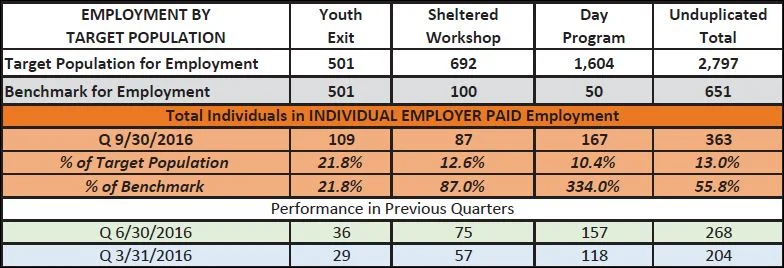
Rhode Island appears to be meeting almost 60 percent of court-mandated goals in placing adults with developmental disabilities in jobs paying at least minimum wage, according to newly-released figures which track the state’s progress through Sept. 30 of 2016.

The state had found jobs for 363 individuals, or 58.8 percent of the 651 placements required at that time, according to compliance figures the state submitted to an independent court monitor in accordance with a 2014 federal consent decree that requires community-based day services to correct violations of the Americans with Disabilities Act.

For one group of individuals protected by the consent decree- those in segregated day programs – the state has made triple the number of required placements. But for other groups, the going has been slower. Only about 22 percent of special education students "exiting" high school got jobs, far short of the 100 percent employment goal. The figures for a third group - adults who had been in so-called sheltered workshops – show 87 percent compliance with the benchmark for job placement at the end of September.

Source: State of Rhode Island 

Source: State of Rhode Island 

Figures at the bottom of the table, set against a pale blue background, allow comparisons among the latest available job placement numbers Sept. 30 and those at the end of the first and second quarters of 2016.

It’s not surprising that the state does not meet overall compliance with the consent decree, Rhode Island began focusing on compliance only in the last 12 months – two years after the agreement went into effect,

In May, 2016, Judge John J. McConnell, Jr. of U.S. District Court reinforced the consent decree with an order addressing numerous shortcomings, including an inability to even get an accurate count of the number of individuals protected by the agreement.

McConnell required the state to create a “live” database, always up-to-date, on the population protected by the consent decree – at latest count 3,456 teenagers and adults – that the monitor and the U.S. Department of Justice could use to gauge compliance.

Such an up-to-the-minute database is in the works but has not yet been completed. In the interim, the  Executive Office of Health and Human Services has coordinated a cooperative effort involving three state agencies and the Sherlock Center on Disabilities at Rhode Island College to connect different sources of data so that the state can make detailed reports to the court, albeit with a time lag. The three state state agencies participating in the combined data effort are the Department of Behavioral Healthcare, Developmental Disabilities and Hospitals; the Department of Education, and the Office of Rehabilitation Services.

The ten-year consent decree has progressively stiffer requirements, with the latest deadlines occurring Jan. 1. It is not yet known how well the state has done against these most recent benchmarks.

 Charles Moseley, the monitor,  has concluded that the state has “significantly improved its ability and capacity to gather, aggregate and analyze” data required by the consent decree.

Moseley submitted the state’s figures to McConnell March 3, supplementing two earlier reports. One made recommendations on stepping up job placements and other aspects of compliance. .The other made sweeping recommendations that would put emphasis on the needs of of individuals in the funding process for developmental disability services and would reorganize operations of the state Division of Developmental Disabilities to incorporate a seamless and continual quality improvement effort. Both reports have implications for greater costs.

All of Moseley’s recent reports are likely to come up during the next open-court hearing on the consent decree, now scheduled for 10 a.m. March 10 before McConnell. (Two hearings in January and February had been cancelled.)

The progress the state reported as of Sept. 30 reflect the efforts of privately-run service providers who for years have been working under significant financial and bureaucratic constraints that make it difficult for them to hunt for jobs for clients and support them once they find employment. 

Front-line workers make poverty-level wages, despite a pay increase approved by the General Assembly in 2016. The legislature also set aside $6.8 million to pay bonuses for new job placements and job retention and for specialized training completed by direct care workers. But that program was still on the drawing boards when the latest data was collected.

In his report on data, Moseley noted that the state did not reach goals for career development plans and benefits counseling. Benefits counseling is necessary to ensure individuals make informed choices about the way particular jobs would affect their government benefits, like supplemental security income (SSI.) Career development plans consider long-range goals, and the intermediate steps necessary to achieve them, in a way that aligns activities with individuals’ needs and interests.

Overall, about 43 percent of the entire consent decree population had career development plans. In one of the earlier reports to McConnell, Moseley was critical of the quality of those career development plans. 

Source: Charles Moseley, U.S. District Court Monitor

Source: Charles Moseley, U.S. District Court Monitor

In the table above, "youth transition" refers to high school special education students likely to qualify for adult services, and "youth exit"refers to adults who have left school since 2013. Other categories refer to older adults who historically have been in segregated day programs or sheltered workshops. The letters CDP are an acronym for career development plan. 

Another table, below, shows that the state had complied with a requirement to provide benefits counseling to young adults with jobs but had failed to similarly advise more than half of older adults who had obtained jobs after 2012. The letters BP are an acronym for benefit plan.

Source: Charles Moseley, U.S. District Court Monitor

Source: Charles Moseley, U.S. District Court Monitor

The state reported that those who had jobs worked an average of nearly 12 hours a week and made an average of about $10.00 an hour. The consent decree says the average work week should be 20 hours.  

The consent decree requires the state to integrate adults with developmental disabilities in their communities to comply with the 1999 Olmstead decision of the U.S. Supreme Court, which reaffirmed the rights of citizens with disabilities to receive services in the least restrictive environment that is therapeutically appropriate under provisions of the Americans With Disabilities Act. In Rhode Island in 2014, the U.S. Department of Justice found an over-reliance on sheltered workshops paying sub-minimum wages and on isolated day programs that did not offer their clients purposeful activities.

Click here for the monitor's data report.

Click here for the data the state submitted to the monitor.


Madden to Leave RI Consent Decree Post; Lawyer Dianne Curran Named New Coordinator

By Gina Macris

Mary Madden, the coordinator of Rhode Island’s efforts to comply with a federal consent decree mandating a transformation of developmental disability services, will step down from that post at the end of March.

Mary Madden                          File Photo

Mary Madden                          File Photo

In her place will be Dianne Curran, a longtime disability rights lawyer who has worked both in Rhode Island and Massachusetts, most recently as a consultant to the Massachusetts Department of Elementary and Secondary Education.

The announcement was part of a public community forum at the North Providence Senior Center Feb. 23 that also catalogued a series of system-wide changes undertaken in recent months, even though developmental disability services still fall short of the funding parents said is necessary to individualize supports for their sons and daughters.

And the audience was reminded that family stories are the ones that make the biggest impact with members of the General Assembly, who in the next several months will consider increases in the current budget and one for the fiscal year which begins July 1.

Curran, al awyer for both Rhode Island Legal Services and the RI Protection and Advocacy System (now the Disability Law Center) during the 1980s, also has served Massachusetts state government in various legal positions in education, human services and developmental disabilities departments. Her lengthy experience in that state includes a brief stint coordinating activities in response to consent decrees affecting adults with developmental disabilities and mental illness.

Madden, a veteran developmental disabilities professional in the private sector, became consent decree coordinator for Rhode Island in January, 2016, at a time when the state was just beginning to craft a response to the 2014 federal consent decree.

 On Thursday, Madden said that continuing as consent decree coordinator “was not in the long-term plan.”  Madden said she would not have returned to graduate studies in disabilitiesand public policy at Rhode Island College if she were not satisfied that that the state had gained momentum in responding to the consent decree. 

Most recently, Rhode Island recruited Kerri Zanchi as director of developmental disabilities after a six-month vacancy in that post.

Zanchi is a career administrator in developmental disability services, who, like Curran, has extensive experience in Massachusetts. She told the audience at Thursday’s forum that she was drawn to the Rhode Island job because of the state’s commitment to community-based services and the opportunity to make lasting change as the state shifts away from isolated day programs and sheltered workshops to comply with the consent decree. The decree requires the state to comply with the 1999 Olmstead decision of the U.S. Supreme Court, which ruled that services for all persons with disabilities must be desegregated in accordance with the Americans With Disabilities Act.

Thursday’s session, attended by about 30 people, was notable for its low-key, conversational tone, a sharp departure from the angry complaints that dominated such meetings during 2016.

In the last six months, developmental disability officials reported, they have made several improvements, including the following:

  • speeded up the application process for adult services for individuals with developmental disabilities and adopted a policy to determine eligibility for adult services by the time special education students turn 17

• named a full time transition coordinator,  Carolee Leach, to work with high schools and the families of their special education students in preparing for adult life

• implemented a modest raise of about 36 cents an hour for direct care workers, as directed by the General Assembly

• introduced revisions to an assessment process used in determining individual funding allocations

• rolled out a supported employment incentive program for private service providers whohave placed 20 adults with developmental disabilities in jobs in the community since January

An independent court monitor in the consent decree case, however, has said in a recent report that the state must do much more to comply with the consent decree. (Click here for article on monitor’s latest report.)

At the meeting,  Zanchi, Madden and several other officials, including Jennifer Wood, General Counsel to the Office of Health and Human Services, heard from parents who said their adult children are lacking individualized community-based services.

Pat Abbate

Pat Abbate

Pat Abbate, who has a 46 year-old son with significant challenges, said the agency which serves him has good intentions but does not have enough financial resources to individualize services in the community

Tammy Russo, who has a 21 year-old son with disabilities, said he gets “no community services except for me.”

Greg Mroczek said 70 percent of his daughter’s program is in a day center isolated from the community.

Earlier in February, the same developmental disability officials heard a similar theme – a lack of adequate funding - from a mother who said she was forced into managing her daughter’s services because no agency would take her. Mary Genco said she asked 19 agencies, and each one said it had no nurse who wanted to deal with her daughter’s medical needs.

Genco, who is home with her daughter nearly all the time, said she represents growing minority of aging parents who are being “worn out” by adult children with extensive medical or behavioral support needs.

On Thursday, Pat Abbate put numbers on the funding gap. She said – and a check of the state’s Office of Management and Budget (OMB) website confirms – that funding for developmental disabilities lags behind the high of $260 million enacted by the General Assembly for the fiscal year between July 1, 2007 and June 30, 2008. At this time last year, the enacted budget was just shy of $231 million, according to OMB documents.

In response to a federal court order which said the state did not allocate enough money to implement the consent decree, Governor Gina Raimondo later pushed for increases, approved by the General Assembly, which boosted the bottom line to $246.2 million in the current fiscal year.

In her most recent budget proposal in January, Raimondo seeks an additional $4.4 million to finish the current fiscal year, for a total of $250.6 million. For the next fiscal year, beginning July 1, Raimondo has asked the General Assembly for $256.7 million.

Heather Mincey, a developmental disabilities administrator, said, “With our budget we try to advocate for as much money as we can.”

Brian Gosselin, chief strategic officer at OHHS, explained that the various departments of state government are active in their own advocacy, working with OMB and the Governor’s office, from July through December. But the state agencies don’t control the allocations, he said.

With the governor’s budget proposal now in the hands of the General Assembly, Gosselin and Mincey agreed, it’s vital that the community speak up.

“It’s important for families and advocates to be out there to speak to their representatives and let them know what your needs are,” Mincey said. 

A member of the audience, who said he works for a developmental disability service agency in Massachusetts, drove home Mincey's and Gosselin’s message.

The voice of families and advocates for developmental disability services is much stronger in Massachusetts than it is in Rhode Island, he said.

“When a family member calls up and gives them (legislators) a story, it makes such an impact,” he said. “I don’t think enough people get that point” in Rhode Island.


RI Gov Appoints Wallack HHS Secretary; Wood To Continue to Lead DD Effort; UHIP Woes Continue

By Gina Macris

The Rhode Island Department of Human Services has begun re-hiring - months after it laid off about 70 workers in conjunction with the roll-out of a dysfunctional automated benefits system – to help Rhode Islanders who face hardships from delays and denials caused by the broken computer system.

That is but one step going forward that Governor Raimondo announced at a media briefing Wednesday, Feb. 15, when she released a scathing report on the Unified Healthcare Infrastructure Project, or UHIP, compiled by Eric Beane, the acting director of the DHS and her chief operating officer.

Blaming the vendor, Deloitte, for delivering a “defective system,” Raimondo also warned that it will take 60 to 70 days to stop the backlog in applications from growing and about a year to fix the system.  Beane’s report, completed over the last thirty days, showed the problem was much worse than she had previously believed, the Governor said. 

She apologized to Rhode Islanders for a situation she said was “unacceptable, inexcusable, and intolerable.”  

She introduced Anya Radar Wallack as the new Secretary of Health and Human Services  (HHS). Wallack formerly served as Medicaid director and the director of the state’s health insurance exchange under the Affordable Care Act.

Elizabeth Roberts, who had made a career of health care reform as a state senator, lieutenant governor and HHS secretary, submitted her resignation Wednesday. Raimondo accepted it, she said, because she agreed with Roberts that the problem needed a “fresh set of eyes.”

 Roberts had taken the stance that the system could be fixed quickly, despite the glitches, but Beane’sunvarnished analysis showed that not to be the case, Raimondo said. 

As Roberts’ long-time deputy, Jennifer Wood had been heavily involved in trying to fix the troubled UHIP rollout. Wood, who has served both as Deputy Secretary and General Counsel of HHS, will continue as General Counsel and will remain in charge of the state’s efforts to comply with the 2014 federal consent decree mandating integration of daytime services for adults with developmental disabilities, according to Beane.

Among thousands who have suffered hardships from the UHIP fiasco are individuals with developmental disabilities applying for adult services from the Department of Behavioral Healthcare, Developmental Disabilities and Hospitals (BHDDH).

Last September, just as BHDDH solved an eligibility backlog in applications, many of them from young adults leaving high school, the introduction of UHIP caused months-long delays in the release of the money necessary to actually pay for approved services. In December, there were an estimated 100 young adults who had services delayed or expected services to be delayed as a result of the UHIP snafu, according to one informal report from the Rhode Island Parent Information Network.

Timely service is an issue of concern to an independent court monitor in the enforcement of a 2014 federal consent decree requiring community-based developmental disability services.

At the press conference, Beane said the backlog in all types of applications will continue to grow unless there is a “staffing surge to address the timelines.”

Beane’s report said Deloitte assured the state the computer system was ready to go live when it was not.

Raimondo said the state continues to withhold tens of millions of dollars (about $68 million of a $364 million project)  and is re-negotiating its contract with Deloitte. “It’s tense,” she said.  But she emphasized that UHIP can be fixed.

Raimondo said she has come to realize that the state needs to have more high-level officials with the technical expertise to analyze a vendor's claims and call out mistakes. In general, the public sector has been lacking in that regard, she said.

There had been warnings from federal officials that the computer system was not ready for a state-wide roll out, but human services officials decided against a try-out period.

Former DHS director Melba Depena Affigne and her chief digital officer Thom Guertin resigned in January under pressure from Raimondo. 

Click here to read Beane's report

Roberts Resigns as RI Health and Human Services Secretary; Wood's Future Role Unclear

By Gina Macris 

Rhode Island’s Secretary of Health and Human Services, Elizabeth Roberts, resigned late Tuesday, Feb. 14, over the quagmire created by UHIP, the state’s computerized human services benefits system.

Governor Gina Raimondo, in a press conference outside her office, said she met with Roberts “and she presented me with her resignation, which I accepted.”

“It was her choice, and I commend her for it. I think she realized, as I realized, that the challenges we’re having with UHIP require a new set of eyes, and a fresh set of eyes. “

Roberts’ top aide for many years, Jennifer Wood, who is Deputy Secretary of Health and Human Services, has been involved closely with the roll-out of the UHIP computer system and also has directed the state’s compliance effort with a 2014 federal consent decree affecting adults with developmental disabilities.

Asked whether Wood’s position is at all affected by the problems of the UHIP rollout, Raimondo’s spokesman, David Ortiz, said in an email that the Governor would give a “full update” on Wednesday.

The resignation came on the eve of a briefing Raimondo has scheduled for the media on Wednesday, Feb. 15, to discuss an analysis of UHIP conducted during the last month by her chief operating officer, Eric Beane, and steps that will be taken going forward.

“Secretary Roberts has been in public service for decades and has done so many good things for the people of Rhode Island,” Raimondo said.

In a statement, Raimondo said Roberts has “fought her entire career to expand access to affordable healthcare for more people. As my Secretary of Health and Human Services, Elizabeth played a key role in our successful efforts to drive Rhode Island’s uninsured rate to one of the lowest in the nation while reducing costs.”

Roberts was criticized by Nicholas A. Oliver of the Rhode Island Partnership for Home Care.

In a statement, he said that “Roberts’ rigid view of the state healthcare system blinded her from understanding the realities of operating healthcare practices and agencies in Rhode Island.”

“Because Roberts was a visionary stemming from her healthcare public policy interest as a state senator and a lieutenant governor without practical operational experience as a healthcare provider, her naivete and inexperience led to her ineffectiveness in the role of Secretary,” Oliver said.

Roberts’ is the third resignation connected to the $364 million computer fiasco. Melba Depena Affigne, director of the Department of Human Services, and her chief digital officer, Thom Guertin, resigned in January under pressure from Raimondo. 

Monitor Seeks Changes in BHDDH Funding Methods To Satisfy RI Consent Decree

By Gina Macris

Rhode Island’s method of allocating funding to adults with developmental disabilities does not meet the requirements of a 2014 consent decree in that it does not take into sufficient account the needs and goals of the individuals involved, according to a new report from an independent court monitor.

The monitor, Charles Moseley, wants the state to review and modify its methods of assigning funding to make sure that “service dollars are targeted to meet the individual’s personal goals and preferences.”

That’s not all. In a report submitted to the U.S. District Court Feb. 10, Moseley incorporated recommendations from outside experts that would bring sweeping changes to the organization of the state Division of Developmental Disabilities (DDD).  (A court hearing scheduled for Feb. 14 has been postponed.) 

The report focuses on the degree to which community-based non-work services are individualized, concluding that Rhode Island has a way to go to achieve compliance.

It also incorporates recommendations from a quality improvement expert who suggested a merger of fragmented licensing, investigative, and program improvement functions at DDD, clearer regulatory standards, and a more precise definition of the future role of the social worker in light of burdensome caseloads (last reported by the state at 205 clients per worker.)

The consultant, Gail Grossman, a former Massachusetts state official, envisioned a unified and continual quality improvement initiative encompassing both DDD and the Office of Rehabilitation Services at the state Department of Human Services.  Both agencies oversee employment-related  services for adults with disabilities.

Grossman said there should be enough staff to review the performance of 38 service providers every two years. ORS now has only enough staff to make the circuit every nine years,  which Grossman found “totally insufficient.” 

The court monitor asked the state for quarterly progress reports, beginning April 1, on its progress in meeting a number of goals. They include specific quality improvement recommendations made by Grossman as well as modifications in funding methods and other changes necessary to personalize the planning and delivery of services according to the needs and preferences of individuals entitled to them.

Recommendations concerning the funding of individualized services resulted from a review undertaken in November by Moseley, A. Anthony Antosh, director of the Sherlock Center on Disabilities at Rhode Island College, and a Vermont-based independent consultant, William Ashe. They examined the non-work community-based services provided to a sample of 21 adults with developmental disabilities who had widely varying profiles.

From Ashe’s report on the study of 21 individuals and from other data, Moseley concluded that so-called “person-centered” planning and community-based services do not meet the requirements of the consent decree.

The consent decree defines “person-centered planning” as a “formal process that organizes services and supports around a self-directed, self-determined and goal-directed future.”  It gives additional detail on how such a plan is to be written.

Ashe and Moseley emphasized that the person-centered plan should drive services, not a funding formula based on a person’s ability to function independently, as is currently the case.

“The funding that agencies receive is based on assessed ‘functioning level’ and not based upon what people may want or really need,” Ashe wrote.

Moseley put it this way: there should be a connection between a “person-centered planning process” and funding methods so that “service dollars are targeted to meet the individuals personal goals and preferences.”

Moseley also wants the state to strengthen its oversight and the capacity of private providers to deliver “truly person-centered plans and services based on clear standards and expectations.” 

Ashe said the annual plans written for the 21 individuals in the study were too similar. The state’s planning process “feels rigid and automatic,” and an individual’s current plan “may often look remarkably similar to the one that was done last year.”

“Agencies are often in a situation where their staffing levels prohibit them from individualizing supports to the extent that is necessary to really implement services that are based upon real choice, ” Ashe wrote.  

What appears to be lost in the allocation process is an idea of the outcomes that are important for the persons involved, Ashe said.

Ashe said the consent decree recognizes that the state uses the Supports Intensity Scale, a standardized assessment tool, to determine an individual’s need for support.

The current funding method connects the results of the assessment to one of five allocation levels, based on an algorithm developed by a healthcare management consultant for the state. Planning for services occurs only after funding limits have been established.

In some of the case records reviewed by Ashe, Moseley, and Antosh, it was “exceedingly difficult to see how the service to be delivered could ever be realized to the standard expected by the consent decree,” the report said.

For most of the individuals whose services were reviewed, the choice of activities was limited..

Ashe placed a high priority on training for everyone involved in developmental disability services -  private providers as well as state workers, services recipients, their families, and advocates - on the meaning of purposeful activities in integrated, community settings and how to provide them.

Click here to read the monitor's report. 

One In Six DD Jobs in RI Goes Unfilled; Raises Would Ease Crisis and Improve Service Quality

image by capitol tv 

image by capitol tv 

Kevin Nerney of the Rhode Island Developmental Disabilities Council, left, and Maureen Gaynor, second from right, share pleasantries just before their testimony before the House Finance Committee on Feb. 8. Looking on are Gaynor's support worker, Melanie Monti, and Emmanuel Falck of the Service Employees International Union State Council.  Image by RI Capitol TV. 

By Gina Macris

Raising the pay of Rhode Islanders who serve adults with developmental disabilities is not only about helping these poverty-level workers pay their bills, according to testimony before the House Finance Committee Feb. 8.

The proposed raises also will reduce staff turnover and, in turn, improve the quality of life for some of the state’s most vulnerable citizens, Donna Martin, executive director of the Community Provider Network of Rhode Island (CPNRI), told the legislators. 

Kerri Zanchi, the new director of the Division of Developmental Disabilities, agrees with Martin’s assessment. Zanchi says the pay hike is not only an “investment in the direct service professional, but an investment in our community" and in high quality services.  

She estimates that the wage increase will amount to an average of 42 cents an hour, and says that provider agencies are now experiencing a staff turnover rate of about 33 percent.

Carol Dorros, the mother of a 21-year-old man with behavioral issues and other complex problems, knows firsthand the value of support staff retention. When her son was still in high school and receiving some adult services from a private agency, his support worker changed four times during a single academic year. As a result, he made “no progress” from September to June, Dorros said.

 Maureen Gaynor rolled up to the speakers’ table in a power chair and used a computerized voice to speak the text she had written with a “headstick,” a pointer attached to a band around her head.

These people deserve higher pay, Gaynor said, explaining that support staff sometimes must help with the most intimate care, such as bathing, dressing and using the toilet.

And she reminded the legislators that she would not have been able to attend the hearing without an aide willing to drive her to the State House and get her to the basement hearing room.

After she spoke, Kevin Nerney of the Rhode Island Developmental Disabilities Council reinforced her remarks:  “When you help someone eat, drink or bathe, you need to have a really good relationship with that person. We’re not talking about folding shirts at the Gap or flipping burgers at McDonald's,” said Nerney.

At AccessPoint RI, a service provider, the starting salary is $10 an hour, or $22,000 a year, said the agency’s executive director, Tom Kane. The average pay was $10.82 an hour until the current fiscal year, when the General Assembly set aside $5 million for raises for developmental disability workers – the first pay increases since 2006, Kane said.

The added funding resulted in a 36-cent hourly increase, raising the average to $11.18, according to calculations made by service providers and others.

When Kane reviewed the the roster of employees at the time his agency processed the raises last fall, he said he was heartbroken to find a 30-year employee who was to receive a total of $13.10, with the pay bump.

Kane and others indicated they believe that a “15 in 5” campaign to raise the pay of direct care workers to $15 in five years (by July 1, 2021), is simply not enough.

Kane alluded to a drive launched by State Sen. Louis DiPalma, D-Middletown, last fall when he asked Governor Raimondo to include a raise for direct care workers in her budget proposal for the next fiscal year.. While she has done so, her $6.2 million set-aside for wages is about $$600,000 shy of what DiPalma requested.

Kane said raises should not only be based on a percentage increase.

 “A four or five percent increase on an insufficient wage is an insufficient increase,” he said.

If the minimum wage increases to $10.50 an hour, as Governor Raimondo has proposed, “and we give 5 percent” raises, Kane said, “we’re paying minimum wage again.”

Kane took issue with figures presented by Linda Haley of the House Fiscal Staff that the raises in the current budget also bumped up pay for supervisory personnel.

He said the raises all went to direct care workers, (as stipulated in current state budget.)  Some agencies, including AccessPoint, used other funding sources to provide raises or bonuses to supervisory employees.

At AccessPoint, Kane said, front-line supervisors spend half their time doing direct care anyway.

“It is incredibly important that this bill passes, hopefully with more money in it,” to support not only those providing direct care but people who perform other important tasks, like writing clients’ state-mandated individual support plans, which are akin to road maps for services that are specific to each client. Most of these employees “have not had a raise in 11 years,” he said. “I don’t know why they stay.”

Emmanuel Falck of the Service Employees International Union (SEIU) State Council represents 270 workers at the Arc of Blackstone Valley. One of them, a 52- year-old woman with 20 years’ experience in the field, used to be able to make ends meet by working 60 to 65 hours a week, he said.

But after an 18-month bout with cancer, the most she can now work is 20 hours a week. And the last vacation she had was three days in Washington, D.C., in 2000, Falck said.

He said the proposed 42-cent increase to the hourly rate would be much appreciated, but the state needs to move faster to raise workers’ pay to a living wage.

“I urge this committee to bump it up as fast as possible,” he said, proposing a $15 hourly wage by 2019 instead of 2021. As it is, direct support workers living in Rhode Island will be able to cross the state line to neighboring Massachusetts and do the same work for $15 an hour on July 1, 2018, Falck said.

Donna Martin, the CPNRI director, said that developmental disability service providers face a “tremendous crisis” in competing for the same pool of workers who serve elderly clients, thanks to a growing number of aging baby-boomers.

On average, the 27 providers belonging to CPNRI cannot fill one in six job openings, creating a vacancy rate of about 16 percent, she said. During exit interviews, workers say that they love their jobs but can’t feed their families with what they are paid, according to Martin.

As a result of the vacancies, employers are forced to spend money on overtime that they would rather put into worker pay and training, Martin said.

“I appreciate your sensitivity to the struggles of our staff,” Martin told the finance committee members.  “They are where the rubber meets the road when it comes to quality.”

Chris Semonelli of Middletown, the father of a 14-year-old girl with autism, put some historical context around the discussion of the wage proposal.

From 2006 through 2011, the budget for developmental disability services was reduced 20 percent, Semonelli said, quoting a profile of the system written by the Sherlock Center on Disabilities at Rhode Island College in 2013. And the services are not designed with an eye toward results. In the current design, more money gives more of the same service, he said.

That said, Semonelli said he strongly supports Governor Raimondo’s proposed wage increase in the next budget, as well as the “15 in 5” campaign. The governor’s plan for the next fiscal year “is a start,” said Semonelli, who also is co-director of an advocacy group called Friends of the Disabled on Aquidneck Island.

Although Wednesday’s hearing sounded like a budget discussion, it focused only on Article 23 – one of 24 chapters in the overall fiscal package Raimondo has submitted to the General Assembly.

The provision would require a one-time increase in the base pay of direct care workers, “in an amount to be determined by the appropriations process” and also require the Office of Management and Budget to perform an audit to ensure that the raises go only to those workers. 

Plan To Boost DD Worker Pay in RI Gets House Finance Hearing Wednesday

By Gina Macris

Rhode Island Governor Gina Raimondo’s proposed pay raise for workers providing direct care to adults with developmental disabilities will get a hearing before a subcommittee of the House Finance Committee Wednesday, Feb. 8.

Raimondo has set aside $6 million for 5 percent wage increases for these workers, who are now paid an average of $11.18 an hour. Her proposal would increase their hourly pay by about 56 cents, to an average of $11.74.

The governor's budget says that poverty-level wages for these workers have resulted in a “hiring crisis” that “impedes the ability of community agencies to implement the state’s obligations” under provisions of a federal consent decree mandating reforms in the developmental disability service system to comply with the Americans With Disabilities Act.

Low wages have led to annual turnover estimated at 33 percent,  with agencies experiencing staff vacancy rates of up to 25 percent, leading to high overtime costs and worker burnout, according to the budget document. The shortage of workers in Rhode Island is all the more challenging because neighboring Massachusetts and Connecticut pay about $1 to 2 dollars an hour more for the same work..

Moreover, Massachusetts has committed to a $15 hourly rate by 2018 for direct care workers in field of developmental disabilities. There is a similar drive in Rhode Island to raise workers’ pay to $15 in five years, but the budget provision to be heard Wednesday deals only with the fiscal year beginning July 1.

The hearing is scheduled after the full House ends it session, he end of the House session, about 4:30 to 4:45 p.m. and it will be held in Room 35 in the basement of the State House.

Kevin Nerney, spokesman for the Rhode Island Developmental Disabilities Council, urges individuals concerned about the stability of the developmental disability service system to attend the hearing or write or call members of the legislature.  Click here for the meeting agenda, which includes a link to the full text of the proposal to increase wages, as well as another budget article to be heard the same day in connection with the duties of the Department of Behavioral Healthcare, Developmental Disabilities and Hospitals in treating substance abuse.

Written testimony also may be submitted to the House Finance Committee through its clerk, Christopher O’Brien, at cobrien@rilegislature.gov.

Monitor Wants Mountains of Details to Push Compliance With RI Olmstead Consent Decree

By Gina Macris

If the state of Rhode Island were building a network of roads to help adults with developmental disabilities get to their jobs, town libraries, or classes at the local Y, then construction could be described as well underway.

But that’s not to say the infrastructure is complete and travelers are rushing to use these new highways on their way to richer lives. 

This image of a work in progress serves, in effect, as a snapshot of what a federal court monitor sees in an ongoing transformation of the state’s developmental disability service system. 

In a recent report to U.S. District Court Judge John J. McConnell, Jr., Charles Moseley says Rhode Island has made solid gains in its efforts to comply with a 2014 consent decree enforcing the Olmstead decision of the Americans with Disabilities Act, which requires disability-related services to be offered in the least restrictive setting that is therapeutically appropriate. And that setting is presumed to be the community. 

The state has increased funding by $11 million, filled key leadership posts, offered more training, and put into place policies and programs to help adults with developmental disabilities find jobs and enjoy activities in their communities.

Priorities for Compliance 

 While acknowledging these efforts, Moseley indicated the state is still out of compliance with the consent decree. Among his top recommendations, Moseley said the state must:

• Strengthen supported employment for young adults up to the age of 25. Job placements for young adults are “significantly below consent decree requirements,” he said.

• Increase funding to expand supported employment and community-based, integrated day services during the next fiscal year, beginning July 1, and in future budgets. The state “needs to take steps to ensure additional funding is available to address caseload increases” related to special education students moving to adult services, he said.

• Increase providers’ capacity to provide services. “Provider agencies do not yet have the numbers of trained staff needed to ensure the provision of services and supports required by the consent decree” Moseley said.

• Eliminate service delays.

Moseley says the Division of Developmental Disabilities (DDD) and the Office of Rehabilitative Services (ORS) have said that service providers can meet the need for employment and community –based supports required by the consent decree.

“But families of individuals with IDD (intellectual or developmental disabilities) who are requesting DDD services for the first time have reported to the monitor that access to needed supports has been prevented or delayed by providers who refuse to accept new referrals,” Moseley said.

“Provider refusals appear to be directly linked to DDD payment rates and rate setting practices,” he said.

Twenty-two of the state’s 36 private service providers have agreed to participate in a program of one-time bonuses paid for staff training, job placements, and job retention, according to state officials. 

That initiative is still accepting applicants and cannot yet be evaluated, Moseley said, although it is expected to ease the service gap over time.

Moseley found it “important to note,” however, that the state has not offered any other kinds of incentives to agencies that chose not to apply to the incentive program, or to providers that did not receive start-up costs to convert sheltered workshops and day programsto community-based operations.

Moseley is asking the state to give him an accounting by Feb. 28 of the number of clients who were refused or faced service delays between July and December of 2016, including the names of the agencies, the reasons given, the length of any delay, and the state’s recommendations for improving access to services.

He also gave notice that he will want a similar report for the three-month period between January and March, as well as another update at the end of June to use as a guide in determining whether recent initiatives put into place by the state are having a positive impact.

State is Playing Catch-up

Moseley submitted a 48-page report to McConnell Jan. 25 in anticipation of a hearing Feb. 14 on the status of the consent decree.

The state’s positive momentum, supported by the $11-million budget increase, is all the more significant because most of it has been accomplished in the year since McConnell became personally involved in the enforcement of the consent decree in January, 2016.

After McConnell signaled he would take the bench on the case, the direct day-to-day supervision of the developmental disabilities division has shifted from the Department of Behavioral Healthcare, Developmental Disabilities and Hospitals to Jennifer Wood, Deputy Secretary of the Executive Office of Health and Human Services.

Even though Wood has put efforts to comply with the consent decree into overdrive, the state is still playing catch-up with the progressively stiffer requirements of the highly prescriptive agreement, which was marked by two years of inactivity at the outset.

The consent decree, signed April 8, 2014, has a ten-year term. At the end of 2015, seeing little progress, the U.S. Department of Justice and the court monitor asked McConnell to take the case under his wing.

During the most recent hearing, in September, 2016, the state avoided contempt proceedings for failing to hit two targets. One of them, the disbursement of raises for direct service workers, was accomplished Oct. 1. The other was the lag in employment of young adults – a problem that has only grown bigger.  At the same time, McConnell said he relied on Moseley to hold the defendant’s “feet to the fire.”

Moseley Wants More Information

Even at the September hearing, Moseley was digging deeper. He pressed the state to better identify young adults and high school special education students who should be counted as members of the consent decree population and enjoy protections designed to prevent them from living lives of isolation.

Moseley’s report relies on data available as of Oct. 31, but he says the state subsequently informed him that the count of young adults who left school since the 2013-2014 academic year has increased by 350, from 151 to 501. 

The report says 29 of these young adults have received job placements, a number that is more than six months old. The consent decree required “all” members of this group to have at least part-time jobs by July 1, 2016.

The monitor continues to press DDD, ORS, and the Rhode Island Department of Education (RIDE) for more detailed information on several areas of implementation where he sees the state lagging.

By Feb. 28, Moseley wants reports on:

 Staff Training

• a plan outlining how DDD and ORS will provide the monitor regular updates on appropriate training for direct service workers at various agencies who provide daytime services. The current number of trained staff statewide, 396, is too low, he says.

Average Hours Worked

• a plan and strategy for increasing the average number of hours per week worked by individuals in supported employment. The current weekly average, 8.6 hours, falls far below the average 20 hours specified in the consent decree.  Implementation of the plan should begin March 1, Moseley says.

Career Development Plans

• an umbrella “operational plan” for 1) expanding critically-needed training for professionals and families on career development,  2) ensuring more than 3,000 individuals protected by the consent decree have high quality career development plans by June 30, and 3) making provisions for regular updates to the monitor on this topic beginning April 1. Currently, 774 individuals have career development plans, according to Moseley’s data.  These plans are intended not only to describe individualized long-term goals, but to include strategies and a sequence of real-life activities for helping individuals work toward those targets. Moseley said there are signs such details are lacking from many existing career development plans.

High School Internships

• data from RIDE and ORS showing the number of high school special education students who participate in at least two trial work experiences, each lasting a minimum of 60 days. RIDE has indicated it is keeping track of these numbers but has yet to provide the monitor with the information, Moseley says.

• data from DDD showing implementation of a so-called “transition timeline”, including notifications to families and other activities involving special education students in high school that prepare them for adult living.

Benefits Counseling

• a report from DDD on how it will ensure individuals deciding on jobs receive counseling about the way their earned income might affect the government assistance they receive, as well as evidence that the counseling is covering the required information. The monitor found that only 65 people had benefits counseling last June 30, the latest date for which statistics were available.

Moseley also noted that the state has developed a process for individuals to seek a variance if they want to opt out of employment, but no one has applied for one. He said he have more to say about the variance process by the end of the month but wants recommendations from the state by March 31 on ways to improve the variance process.

Employment First Task Force

Moseley addressed the future of the Employment First Task Force, saying it “has the potential to provide an independent and meaningful role in supporting the ability of the State to accomplish the reforms identified by the consent decree." 

“But change needs to take place if the task force is to achieve its full potential,” he said.

The consent decree intends the task force as a bridge between the community and the government, or as Moseley put it, “an independent, voluntary group of advocates and stakeholders who are not directly involved in state agency operations.”

While the consent decree says the group should make policy recommendations, it doesn’t say what areas the task force should research, or to whom it should make its recommendations, said Moseley. He also noted that it has no administrative staff or oversight from any state agency.

Moseley said he wants some changes in the task force “without compromising the separate and independent voice of advocates and stakeholders.”

Ultimately, he wants the task force to make annual reports for the monitor, the state, and the public on barriers to implementing the consent decree and ways to overcome them.

Moseley called on EOHHS to give the task force some staff support. And he asked Kevin Nerney, the task force chairman, and Jennifer Wood, the Deputy Secretary of EOHHS, to convene a small work group to map out the respective roles and responsibilities of the state and task force members and to report back to him by Feb. 28. 

Click here to read the entire monitor's report.

Governor's Budget Would Add Total of $10 million For Developmental Disabilities Through June, 2018

By Gina Macris

A new $6.8-million incentive program, intended to encourage service providers to help Rhode Islanders with developmental disabilities get and keep jobs, will become a permanent fixture of the annual budget, according to Jennifer Wood, Deputy Secretary of Health and Human Services.

That is one of several areas of Governor Gina Raimondo’s budget proposal that indicates the state is moving to increase services for individuals with developmental disabilities in keeping with a 2014 consent decree, which requires Rhode Island to expand their access to employment and other community activity over a ten-year period.  

Wood and other key officials, who are involved in reinventing the state’s developmental disability service system, elaborated on Raimondo’s proposed budget and the way it reflects evolving trends and programs during an hour-long interview with Developmental Disability News on Jan. 24. 

Between now and the end of the next fiscal year, which concludes June 30, 2018, Raimondo proposes to increase spending for developmental disability services by about $10 million, excluding restricted funds and capital expenses.

Of that total, $6 million in federal and state Medicaid funds would be used for five-percent increases to the average wages of direct support workers, and much of the rest would reflect more expensive levels of services needed by individuals with developmental disabilities than have been recognized in the past.

Overall, Raimondo asked the General Assembly to increase the current allocation for developmental disability services by nearly $4.4 million in this fiscal year, which ends in June, from about $246.2 million to $250.6 million.

Excluding restricted and capital accounts, the added amount available for services before June 30 would be nearly $3.8 million, according to a budget breakdown provided by EOHHS. In the budget cycle which ends in June, 2018, the Governor would add a total of about about $6.1 million, for $256.7 million in all spending on developmental disability services. Excluding the restricted and capital funds, the increase would be about $6.6 million.  

All Funds vs Operating Budget

TABLE COURTESY OF EOHHS

TABLE COURTESY OF EOHHS

    GR=state funds     FF= federal funds

The primary reasons that developmental disability services are expected to be more costly include:

  •  The need for a better-paid, more stable workforce, funded with a 5 percent increases in direct care wages, or a total of $6 million 
  • · Additional staff time spent on job hunting and job support for their clients, reflected in the new $6.8 million individualized supported employment program that is already part of approved spending
  • A new version of the process for assessing individual needs appears to indicate that more supports are required than have been recognized in the past.

Supported Employment Program Has Begun Operations

Until now, all individuals with developmental disabilities who sought help in finding jobs in the community had to give up other kinds of services, with the dollar value of their personal funding authorizations remaining the same. But those enrolled in the new “person-centered” supported employment program, now accepting applicants, will get job support in addition to their other services, according to an EOHHS spokeswoman. The program is expected to involve about 200 clients.

The supported employment program was funded by the General Assembly with a $6.8 million allocation for the current fiscal year. But that sum has been untouched while the state has figured out how the program will work.

The program is poised to make its first disbursements to service providers, including incentive payments for the placement of two individuals in jobs in January. said Tracey Cunningham, Chief Employment Specialist in the Division of Disabilities at the Department of Behavioral Healthcare, Developmental Disabilities and Hospitals (BHDDH).

The original $6.8 million allocation is expected to fund the incentive program into the second half of the fiscal year ending in June, 2018, according to an EOHHS spokeswoman.

The program staff will evaluate the results of the first operational year to determine how much money it will need to continue, said Brian Gosselin, the Chief Strategy Officer at EOHHS. Wood promised assured continuous funding for the program.

“What we hope to learn in the first 12 months of this brand new program is what impact $6.8 million will have,” Gosselin said. It provides one-time incentive payments when staff complete a specific training program and clients are placed in jobs. The program also pays bonuses for employment retention, in two installments, after 90 and 180 days.  

Gosselin said he and his colleagues will determine whether the $6.8 million allocation was enough and will identify the successful features of the program that can be used in the second year.

He and Wood were asked why the 22 providers participating in the program must continue to use a fee-for-service reimbursement model which requires them to bill for daytime services in 15-minute increments.

Gosselin said that is the funding model that the federal Centers for Medicare and Medicaid services has approved for daytime developmental disability services in Rhode Island.

“In order to make any adjustments to that methodology we would have to go through a very long approval process with the federal government,” he said.

But he emphasized that the new performance-based aspect of the incentive program is “what we hope to learn from.”

A discussion of the fee-for-service model and whether it works for Rhode Island is part of a larger conversation – redesigning and renewing the state’s Medicaid waiver, which is expected to occur in 2018, Gosselin said.

Wood emphasized that she didn’t want to conflate two things. “One is Medicaid billing” and the other is “programmatic contracting,” she said.

“What we set forth to do was to create the first instance in Rhode Island of performance-based contracting for outcome-based services provided to individuals with developmental disabilities. We are super-excited about that,” she said. “That’s a whole new direction for this world.”

Wood also elaborated on the design and roll-out of supported employment in the context of a U.S. District Court order reinforcing the 2014 consent decree, which had set an Aug. 1 deadline for implementation of the performance-based supported employment program.

“Implementation is an ongoing activity,” Wood said. “We met the requirements of the Court order by filing with the monitor and the Court and the DOJ (U.S. Department of Justice) the programmatic requirements” for the supported employment services program last summer, Wood said. The “person-centered” program is designed to put the needs and preferences of the client at the center of the job-hunting and support process.

Since the summer, state officials have met with providers, drawn up contracts and finalized them, she said. The next phase of implementation is enrolling clients, Wood said.

“We are actually quite proud of the fact that we can bring this program up in what in government circles is lightning speed,” she said, “and to do it in a really reliable, viable, and responsible way.”  .

“I know it may not appear that way to the public,” Wood said.  She apparently alluded to public criticism of the program, which was not completely fleshed out when it was first presented to providers in November and was not widely understood by families who direct individualized services for a loved one.

Wage Increase Intended to Help Stabilize Workforce

Governor Raimondo’s proposed $6 million for wage increases for direct care workers would provide about 5 percent more in the hourly rate, before taxes, in the fiscal year beginning July 1.

For the current fiscal year, the General Assembly approved about $5 million for a pay raise which boosted the average hourly rate from $10.82 to $11.18.   Another 5 percent would raise the average hourly rate by 56 cents to $11.74.

Governor Raimondo’s latest proposal also would provide an increase for employer-related costs for direct care workers, Wood said. 

Raimondo had been asked to include another pay increase for direct care workers in her budget plan from State Sen. Louis DiPalma, D-Middletown, First Vice Chairman of the Senate Finance Committee.

DiPalma said in a recent telephone interview that he considers Raimondo’s wage proposal for Fiscal 2018 the first step in a five-year effort to raise direct care salaries to $15 an hour.

In the meantime, the minimum wage may well be on the rise as well. The Governor’s budget proposal would increase it from $9.60 to $10.50, while Rep. Leonidas P. Raptakis, (D- Coventry, West Greenwich, and East Greenwich) has countered with a $10 minimum wage bill.

 DiPalma was asked whether a $15 hourly rate would be enough for the direct care workers in five years.

He said he plans to introduce legislation this year to link the wages of direct care workers to the consumer price index.

“We can’t tie the hands of future legislatures,” by committing them to specific dollar amounts in advance, DiPalma said.

“It’s a case of wanting people to have an appreciation for the intent of what we want to do” in placing value on the work of those who care for some of the state’s most vulnerable citizens, he said.  

A spokeswoman for the Executive Office of Health and Human Services said DiPalma and Senate President M. Teresa Paiva Weed, who backs the so-called “15 in 5” plan, “have been important partners in advocating for investments in our direct care workforce.”

“We look forward to working with our partners in the General Assembly to implement our second wage increase this year, as well as increases over multiple years as possible,” said the spokeswoman, Sophie O'Connell.

A year ago, a conference hosted by the Sherlock Center on Disabilities at Rhode Island College concluded that higher wages are a critical component in stabilizing the direct care workforce nationwide. In Rhode Island, the average annual turnover is about one third, according to the Community Provider Network of Rhode Island. That means that an adult with developmental disabilities, who relies on a good relationship with caregivers, can expect that every year, one out of every three staffers will  to the job.

Revised Individual Assessment Suggests Greater Cost

Unexpected  increases in billing from private service providers, as well as higher projections for future costs, would add an additional $5 million to federal and state-funded Medicaid-services for existing clients in the current fiscal year, according to the Governor's budget brief. (Some of that net increase would be offset by other savings.) 

In November, the Division of Developmental Disabilities began using an updated version of an assessment called the Supports Intensity Scale (SIS) in determining the needs of individual clients. Those assessments are used to assign individual funding authorizations for support services.

“I personally am really thrilled” over the implementation of the new version, called the SIS-A, Wood said. “I know all my colleagues in government feel the same way about it.”

She acknowledged that “there have been all sorts of questions in the past about the validity and reliability of the state’s approach to implementing the SIS.”

And it’s an emotional topic because it’s not just an evaluation, but one linked to funding supports for a loved one, she said.

Since the SIS was implemented in 2011, time-consuming appeals of the results and the corresponding funding levels have become common, and appeals were often granted.

In 2014, the DOJ criticized the way the SIS was being implemented in the findings that laid the groundwork for the consent decree.

“The need to keep consumers’ resource allocations within budget may influence staff to administer the SIS in a way that reaches the pre-determined budgetary result,” the DOJ said at the time. 

In the recent interview, Wood said, “We feel much more comfortable and confident about the validity” of the SIS-A.

As it has been explained to her by the experts, she said, the new versions include refined questions that address some of the more complex needs that “people did not feel were being captured in the original version.”

Wood indicated that in general, higher scores on the SIS-A have  prompted developmental disability service officials to project higher individual funding authorizations. 

Apart from three new questions asking whether a client has hypertension, allergies or diabetes, the SIS-A adopts a risk assessment which includes five overarching questions with multiple parts intended to gauge critical health needs, self-injurious behavior or community safety issues. The questions on the risk assessment were released by the Division of Developmental Disabilities in the last week. Professionals say that with proper support, such risks can be overcome.

A lot of effort already has gone into retraining interviewers, Wood said, although “it will take us two to three years to find our way fully in this new assessment.”

Heather Mincey, social services administrator in the Division of Developmental Disabilities, said the training program has addressed the way interviewers ask questions. The Division of Developmental Disabilities is trying to be responsive to families, clients, and service providers who may not feel like they’re being heard or are unsure what kind of information the interviewer is trying to elicit, she said.

At the same, the Division of Developmental Disabilities is continuing an initiative begun a year ago to save about $1.7 million in Medicaid funding, including almost  $846,000 in state funds, from existing individual funding authorizations that exceed levels indicated in past SIS assessments.

There were so many complaints about the SIS in the latter part of 2014 and the first months of 2015 that BHDDH suspended an effort to rein in the exceptions in the fiscal year that ran from July 1, 2015 to June 30, 2016.  But the initiative to  to reduce those exceptions resumed for the current fiscal year, which began last July.

Wood said that budget figures for the current fiscal year and the one ending June 30, 2018, twice listing $845,750 in savings from realignment of individual funding authorizations, don’t represent a new initiative, but a continuation of the one already underway.

The appeal process remains an option for those who disagree with their allocations.

A new policy enacted by the state last July to respond to a judicial order says that all SIS assessments will be based solely on support needs. It also says that only the Director of Developmental Disabilities has the authority to grant authorizations that exceed SIS levels. Until now, appeals have been decided by a team of administrators.

Wood and other state officials have said they hope the SIS-A will result in a reduction in the number of appeals.


RI Governor Raimondo Asks for Wage Hikes for Direct Care Workers in FY 2018 Budget

By Gina Macris

Governor Gina Raimondo is asking the General Assembly to approve a total of $11 million for raises for front-line human services workers who provide homecare or who work directly with adults with developmental disabilities.

The proposal was one of the highlights of a budget plan that includes nearly $1.4 billion in human services funding in an overall fiscal package totaling about $9.3 billion for the2018 fiscal year, which begins July 1. The budget was delivered to the General Assembly Thursday, Jan. 19.

“For home and community-based placements to be successful, the state must have a robust provider network and support system, “ Raimondo said in a statement. ” To build this capacity, workers with the right skills must be paid enough to fill those jobs,” she said.

Jonathan Womer, director of the Office of Management and Budget, told reporters at a budget briefing that keeping direct care workers on the job has been “really difficult.”  Workers in equivalent jobs in Massachusetts make about $13.00 an hour.

The added money for wages includes a 5 percent hike for workers who provide direct services to adults with developmental disabilities, or 56 cents an hour, bringing their average hourly pay to $11.74. Homecare workers would see a 7 percent, or 78-cents-an-hour increase, for a new average hourly rate of $11.96

Raimondo also has proposed raising the minimum wage from $9.60 to $10.50 an hour, an increase of 90 cents.

Since July 1, developmental disability and home care workers have been paid an average of $11.18 an hour, according to figures released by State Sen. Louis DiPalma, D-Middletown. In October, DiPalma asked the Governor to include additional raises in her next budget as part of a five-year plan to raise the pay of front-line workers to $15.

Last May, Raimondo proposed pay hikes in apparent response to pressure from the U.S. District Court, which is monitoring implementation of a 2014 consent decree designed to desegregate day services for adults with developmental disabilities.

Judge John J. McConnell, Jr. earlier had ruled that the state did not spend enough money to provide the community-based services required by the consent decree and risked being held in contempt of court if it did not sufficiently fund supported employment programs.

The consent decree runs out in 2024, and McConnell is still holding periodic reviews of the case. The next hearing is Friday, Jan. 27.

To encourage supported employment, the General Assembly added $6.8 million in the current budget for job coaching and related activities, but that performance-based incentive program is just getting off the ground, five months after a court-ordered deadline.

Budget briefing materials released Thursday were silent on whether the program will continue, and state officials were not immediately able to respond to detailed questions.

Service providers have said the incentive program, set up to provide one-time bonuses for staff training, new job placements, and job retention, is a distraction from the fundamental problem that agencies continue to be chronically underfunded.

Raimondo asked the General Assembly for an additional $4.9 million for caseload growth in fiscal 2018. The General Assembly spurned a similar request last year, with the House leadership saying the numbers showed a stable caseload, at about  4,000 clients. 

House Speaker Nicholas Mattiello has said that if and when the caseload increases, the General Assembly will listen.

In the last few months, the independent court monitor in the consent decree case has required the state to identify all young people over the age of 14 who likely will be eligible for adult developmental disability services in the next seven years, but the state has not yet released firm numbers.

In all, Raimondo would add nearly $4.4 million to the bottom line to cover developmental disability spending for the remainder of the current fiscal year and $6 million more in the next budget.

Those increases in developmental disabilities apparently would by offset by cost-shifting to The Department of Human Services, as well as cuts in funding authorizations to individuals who receive developmental disability services.

Raimondo’s budget message suggested that developmental disability officials plan to save about $850,000 in state revenue during the remainder of the current fiscal year and an equal amount in the next one by cutting individual funding authorizations to adults with developmental disabilities to “appropriate resource allocation tiers.”  

In the past few years, such attempted cuts have been routinely contested  -- often successfully -- by service providers and families in time-consuming appeals involving a controversial individual assessment called the Supports Intensity Scale.

All developmental disability services are funded by a combination of federal Medicaid and state revenue at a rate of roughly 1 to 1, and the governor’s request for increases come in spite of increased pressure on overall Medicaid costs.

The current authorized spending level for all developmental disability services is $246,242,419. Raimondo’s supplemental budget would raise that total to $250,626,970 by June 30. The spending limit for Fiscal 2018 would increase yet again to $256,707,760, according to her plan.

Developmental disability services make up more than 60 percent of the total BHDDH budget, which is currently $385,632,555. Raimondo would like an additional $15,457,021 for a total of $401,089,575 to close out the current fiscal year. The bottom line for the next fiscal year would be $394,366,931.


Raimondo To Propose Wage Increase for DD and Home Healthcare Workers in Next Budget

By Gina Macris 

(This article has been corrected. Please see the note at the end.) 

In her State of the State address Tuesday, Jan. 17, Rhode Island Governor Gina Raimondo said that her budget for the next fiscal year will include a second round of raises for home health care workers and those who provide direct support for adults with developmental disabilities.

Raimondo said that in 2016, the state gave homecare and direct care workers “their first raise in nearly a decade.” She acknowledged the leadership of Senate President M. Teresa Paiva Weed in that effort.

“And I propose that we give them another raise this year. It will make us more competitive with Massachusetts and help us make sure we have the highest quality people taking care of our Rhode Island families,” Raimondo said.

In 2016, the Governor and the General Assembly faced pressure from the U.S. District Court to put more money into developmental disability services.

After an evidentiary hearing in the spring, Judge John J. McConnell, Jr. ruled that there was not enough money in the state budget to comply with provisions of the Americans With Disabilities Act which require community integration of individuals with disabilities. At the same time, he did not say how much money was lacking,

The General Assembly ultimately approved a budget amendment submitted by Raimondo that added $5 million for developmental disability wages, raising the hourly rate from $10.82 to $11.18. Half is Medicaid money and half is state revenue.

Rhode Island’s minimum wage is $9.60 an hour, although Raimondo signaled on Tuesday that her budget will contain a proposal to raise it to $10.50 an hour. 

On Tuesday, Raimondo gave no fiscal details of her plan for raises. She will unveil her budget proposal tomorrow, Jan. 19, at 4 p.m.

But her speech indicates that she has at least opened the door to a call from State Sen. Louis DiPalma, D-Middletown, for a five-year commitment to increase the hourly wage of developmental disability workers to $15.

DiPalma has asked the Governor to add 76 cents in the average hourly rate to increase it to $11.94 in the next budget. That would mark the first installment in the five-hear plan, according to DiPalma. For developmental disability workers alone, he said, the cost would be an estimated $6.8 million in fiscal 2018..

DiPalma, first vice-chairman of the Senate Finance Committee, unveiled his so-called “15 in 5” plan last October with the backing of Paiva Weed and the chairman of the Senate Finance Committee, Daniel DaPonte.

(This article has been updated to say that wage increases for direct care workers proposed by Governor Raimondo for Fiscal 2018 would be the first installment in a five-year plan to raise their pay to $15 an hour. The original version incorrectly said the initiative marked the second installment in the "15 in 5" plan. )


New ABLE Program, Hailed As "Great Opportunity," Allows Disabled To Save Without Affecting Benefits

By Gina Macris

RI GEN TREASURER SETH MAGAZINER

RI GEN TREASURER SETH MAGAZINER

A new Rhode Island ABLE savings account program for disability-related expenses, which quietly began accepting applications a few weeks ago, is expected to have a significant impact on the quality of life for individuals who receive Social Security and Medicaid-funded services.

At a State House press conference Thursday, Jan. 12, General Treasurer Seth Magaziner and Health and Human Services Secretary Elizabeth Roberts formally launched Rhode Island’s version of the savings program, authorized by Congress nationwide in 2014 through the Achieving Better Life Experience  Act. The General Assembly passed its own enabling legislation in 2015. 

Until now, adults with developmental disabilities have not been able to accrue more than $2,000 in savings without risking Supplemental Security Income and Medicaid benefits, living in what Magaziner termed a “perpetual state of vulnerability.”

“People with disabilities live in poverty,” said Joseph Ferreira, a member of Magaziner’s staff who has cerebral palsy.

“It’s a terrible thing to have the greatest nation in the world and yet live in poverty,“ Ferreira said, calling the ABLE Act “a great opportunity.” He has worked in the Treasurer’s office for 15 years, he said.

The ABLE program, similar to 529 College Savings Plan programs, will allow individuals and families to save up to $14,000 a year, or a maximum of $100,000, without affecting government disability supports, Magaziner said.

Joseph Ferreira

Joseph Ferreira

Roberts said the ABLE account “does a remarkable job in removing obstacles” from the lives of people who have been hamstrung in any effort to gain greater financial independence - even as a federal consent decree in Rhode Island is encouraging them to work.

M. Teresa Paiva Weed, D-Newport, president of the Rhode Island Senate, said the law is aptly named, because it is a “real program that will help real people” have better lives.

She said families, who often struggle to support children with disabilities once they get out of school, will now be able to save for them in the same way they set money aside  for college-bound youngsters.

Magaziner said that in a “soft launch” of the program about a month ago, a woman with disabilities used her ABLE account in conjunction with a “gofundme” campaign online to raise money for a vehicle modified so she could drive it.

The campaign was set up so that donors’ contributions would go directly into the woman’s new ABLE account, he said. “That’s something I never would have thought of,” he said.

ABLE accounts, managed by Ascensus College Savings, offer savings and investment options, and withdrawals for disability-related expenses are tax-free, according to a brochure distributed at the press conference.

Disability-related expenses may go for education, health and wellness, housing, transportation, legal fees, financial management, employment training and support, assistive technology, personal support services, and other categories.

There is a $40 annual maintenance fee, as well as investment fees of less than four tenths of a percent of the total value of the account, according to a spokesman for Magaziner. A debit card option will be introduced in March.

To keep fees low and maximize investment options, Magaziner said, Rhode Island has joined a dozen states in the national ABLE Alliance, all working with Ascensus as the program manager.

He said he is pleased that Asensus has an office in Warwick. Ascensus’ President and CEO, Jeff Howkins, attended the press conference in the State House Library. 

Magaziner said the program would not have been possible without state legislation enacted in 2015 under the sponsorship of Sen. Adam Satchell (D-West Warwick) and Rep. Robert Nardolillo (R-Coventry.)

Applications are accepted online at ri.savewithable.com or by phone at 1-888-609-8915, from 8 a.m. to 5 p.m., Monday through Friday.

Paper applications will be available at the end of February, according to spokeswoman for the Rhode Island Department of Behavioral Healthcare, Developmental Disabilities and Hospitals (BHDDH). She said employees of several human service agencies are being trained to help applicants fill out the forms.

In addition, the Treasurer's office stands ready to train any organizations interested in helping individuals file applications, she said.

Rhode Island’s ABLE program also has an advisory committee that includes community partners advocating for enrollment. 


Incentive Program for DD Service Providers Closer to Launch, But Lags Months Behind Court Deadline

By Gina Macris

Despite some progress, implementation still lags months behind schedule for a Rhode Island program intended to boost employment of adults with developmental disabilities.

Nor does the design of the program cover the full cost of staff training that is a prerequisite for participation, according to comments made at the monthly Employment First Task Force meeting Jan.10. The new employment supports program does reward private developmental disability service providers that already have trained staff at their own initiative.  

The General Assembly has allocated $6.8 million in the current budget for the incentive program to satisfy requirements of a 2014 federal consent decree requiring the state to boost its efforts to provide employment supports to adults with developmental disabilities.

Einloth                                                             photo by anne peters

Einloth                                                             photo by anne peters

But as the second half of the fiscal year gets underway, it appears that direct service providers have not yet been given the green light to bill for reimbursement under provisions of recently negotiated performance-based contracts, said Kim Einloth, a senior director at Perspectives Corporation.

A total of 19 contracts have been negotiated among 36 service providers operating in Rhode Island, a spokeswoman for the Executive Office of Health and Human Services said last week.

Despite an early morning snow storm Friday, Jan. 6, 18 agencies participated in a fair attended by some 40 special education high school students and another 40 young adults in the process of moving from school to adult life, according to the EOHHS spokeswoman. She anticipated the incentive program will serve about 200 adults with disabilities.

The incentive program was to have been in place Aug. 1, according to an order of the U.S. District Court.

Einloth said during the task force meeting that the director of the Community Provider Network of Rhode Island, Donna Martin, has conveyed her concerns about the program to the independent court monitor in the case, Charles Moseley.

Martin has not responded to requests for comment sent by email from Developmental Disability News.

At the task force meeting, Einloth and Kiernan O’Donnell of the Fogarty Center, another service provider, said that the program would pay a one-time bonus of up to $810 for each staff person trained to offer job-related supports, assuming that person serves ten clients.

O'Donnell          Photo by anne peters 

O'Donnell          Photo by anne peters 

So-called “self-directed” families who design programs for a single individual would get only $81 to cover staff training, O’Donnell said. Neither figure fully supports an investment of 40 hours of class time and extra field work that is necessary for certification, he said, despite EOHHS assertions to the contrary. 

Claire Rosenbaum, Adult Services Coordinator at the Sherlock Center on Disabilities at Rhode Island College, said self-directed families were given four days in November to figure out whether they should apply for the program. The written materials explaining the program were so technical that parents didn’t understand them and set them aside, Rosenbaum has said. As part of her job, she has email contact with some of the self-directed families.

When the application process opened, in November, the state was unable to tell providers exactly how many bonuses they would receive under terms of the incentive program, according to Einloth, although that gap has been clarified.

According to the contracts, once staff are trained, agencies receive bonuses for completion of the course, and may bill at enhanced rates for employment-related services to new clients, Einloth and O’Donnell said in an interview after the task force meeting. .

But the billing must be done in 15-minute increments, they said, in the same fee-for-service reimbursement model that has been criticized by the U.S. Department of Justice and the court monitor as being inflexible.

Other features of the program pay one-time bonuses when clients get jobs and remain employed for 90 and 180 days. 

In the meantime, agencies do not receive enhanced rates for providing the same employment-related services to current clients – only new ones approved by the state as participants in the incentive program, O’Donnell and Einloth said. O’Donnell said agencies now routinely file appeals, one by one, to get better reimbursement for employment-related services for individual clients. O’Donnell said he understands most of those appeals are granted.

The new incentive program appears to draw attention away from the fact that reimbursement rates are too low across the board for providers to do their jobs, O’Donnell said.

He and Einloth also are co-presidents of the Rhode Island Association of People Supporting Employment First, a professional organization.

Meanwhile, a task force member with developmental disabilities, Andrew Whalen, told his colleagues that he had received a letter a day earlier, on Jan.9, notifying him he is eligible for services from BHDDH. Whalen applied nearly a year ago, after the death of his mother in January, 2016.

He first mentioned the long wait for a decision at last month's meeting of the task force, when the discussion touched on the state’s efforts to render speedy eligibility decisions and the effect of continuing human services computer problems on services for adults with developmental disabilities.

.In December, Whalen also said the new computer system – called UHIP – deleted a separate application for food stamps that he had filed. At the most recent task force meeting, he said his application was “on hold” because, thanks to his generosity of his sister, the balance in his checking account was too high. 

Kevin Nerney, chairman of the task force, said that Whalen could solve the problem by moving the excess money to an ABLE account. ABLE, which stands for Achieving a Better Life Experience, is a new type of savings account authorized by Congress and the General Assembly that allows individuals with disabilities to set aside money without compromising their Social Security or Medicaid benefits.

Nerney said ABLE began accepting applications from Rhode Islanders only in recent days at https://savewithable.com Paper applications will be available in March, he said.  

RI Job Seekers with DD May Seek Help at Provider Fair Friday as State Tries to Boost Employment

 By Gina Macris

Rhode Islanders with developmental or intellectual disabilities who want to work can explore the job-development services of 14 private agencies during a fair Friday, Jan. 6, at the Arnold Conference Center on the campus of the state Department of Behavioral Healthcare, Developmental Disabilities and Hospitals in Cranston. 

The fair runs from 9 a.m. to 1 p.m., according to a spokeswoman for the Executive Office of Health and Human Services. 

Of the state’s 36 private providers of developmental disability services, 14 have confirmed their attendance, the spokeswoman, Sophie O’Connell, said Wednesday. 

They are:

·         Avatar Residential, Inc.

·         Bridges, Inc.

·         Community Living of Rhode Island, Inc.

·         Community Work Services

·         Frank Olean Center, Inc.

·         Gateways to Change, Inc.

·         James L. Maher Center

·         Looking Upwards, Inc.

·         Perspectives Corporation

·         J. Arthur Trudeau Memorial Center

·         West Bay Residential Services, Inc.

·         WORK Inc.

·         Work Opportunities Unlimited Contracts, Inc.

·         Seven Hills Rhode Island 

A total of 17 agencies have finalized contracts with the state that will reward them with one-time stipends for staff training in supported employment, the placement of clients, and job retention for six months, according to O’Connell.  

A federal court order required the state to have performance-based contracts in place by Aug. 1, 2016 but negotiations between the provider agencies and the state on the performance-based supported employment contracts dragged on  through December. 

The contracts are intended to help the state comply with a 2014 federal consent decree requiring it to desegregate daytime services that emphasized sheltered workshops and isolated day programs. 

The original job fair flier put out by BHDDH in early December said more than 20 providers would attend Friday’s event, but that projection now appears to have been overly optimistic. O’Connell said the state hopes additional providers will commit to the fair before Friday morning. 

As recently as three weeks ago, members of the community-based Employment Force Task Force created by consent decree expressed concerns that the one-time bonuses in the incentive program were not enough to sustain expansion of job development and supported employment services. 

O’Connell, however, later said that agencies submitting applications for the program were able to “outline their ability to serve both their current clients and new populations.” 

She said Jan. 4 that the state hopes to finalize contracts with all the agencies soon. The state will monitor the agencies’ work in job-hunting and job retention as part of an effort to evaluate the impact of the program in the community, she said. 

Individuals who already are served by a private agency, as well as those who direct their own services, with family support, are welcome to attend.  Questions regarding the event may be directed to Tracey Cunningham, Associate Director of Employment in the Division of Disabilities, at 401 462-3857 or by email at tracey.cunningham@bhddh.ri.gov.

Kerri Zanchi, Former Massachusetts Rehabilitation Official, Named DD Director for Rhode Island

Kerri Zanchi

By Gina Macris

Kerri Zanchi, a former high-level developmental disability service official in Massachusetts, has been named Rhode Island’s Director of Developmental Disabilities in the Department of Behavioral Healthcare, Developmental Disabilities and Hospitals (BHDDH).

Zanchi, who has past ties to Rhode Island, begins her job here Jan. 23, according to Rebecca Boss, acting director of BHDDH.

 “We are certain that she’ll be a strong leader and we look forward to introducing her to you at our upcoming community forums” in February, Boss said.

“She has focused on quality services that encourage independence as well as community integration.” 

Boss said Zanchi embodies four characteristics at the top of the list of qualities identified in community forums held before the search: 

  • ·  hands-on experience with individuals living with developmental disabilities
  • ·   experience with government
  • ·  a deep understanding of how Medicaid works
  • ·  good communication skills

Zanchi, meanwhile, issued a statement saying she accepted the job because of the “tremendous opportunity” and “strong commitment” on the part of state leaders “to transform the development disability system to deliver high quality services that individuals and families deserve.”

She praised the “strong vision and clear goals” guiding the work of the developmental disability leadership team and said she found the community “engaged, with much expertise to offer as this work unfolds.”

“I look forward to partnering with individuals, families, the community and my colleagues in government to build on this momentum and move the service system in a direction that results in better services, better outcomes and more opportunities for all Rhode Islanders living with developmental disabilities,” Zanchi concluded.

Her salary will be $102,860, according to a spokeswoman for the Executive Office of Health and Human Services (EOHHS).

Zanchi, 43, is a native of Massachusetts who grew up in East Lyme, CT. She began her career working directly with adults with developmental disabilities in Rhode Island and received her master’s degree in social work from Rhode Island College in 1999.

After completing her studies, she worked at the administrative level in both the public and private sectors in Massachusetts, rising in 2014 to Assistant Commissioner of the Massachusetts Rehabilitation Commission, one of several agencies falling under the jurisdiction of that state’s Executive Office of Health and Human Services.

The Commission provides an array of services that promote empowerment and independence for individuals with disabilities, according to its mission statement. As Assistant Commissioner, Zanchi provided leadership and advocacy for six departments of state government focused on community living, covering the gamut of concerns from consumer issues to independent living, assistive technology, protection from abuse and specialized services for individuals with brain injuries, according to a resume released by Rhode Island officials.

The resume says she implemented performance management practices and contributed to cross-agency collaboration. These issues are relevant in Rhode Island because of the demands of a 2014 consent decree that requires various state agencies to work together to  desegregate daytime services for adults with developmental disabilities following specific goals set by the U.S. District Court. 

Zanchi left Massachusetts government in the fall of 2015, according to the Massachusetts Rehabilitation Commission’s annual report that year. She became Associate Executive Director of the Center for Living and Working, Inc., based in Worcester, leading the organization through a restructuring that emphasized staff development, quality improvement and performance-based outcomes.

In addition, she served as Coordinator of the Massachusetts Aging and Disabilities Resource Consortium for five partner agencies in central Massachusetts, strengthening community and provider collaborations, according to the resume.

Zanchi will succeed Charles Williams, who retired as Director of the Division of Developmental Disabilities last July 22.

The current budget for the Division of Developmental Disabilities is $246.2 million, providing services for a total of about 4,000 adults with intellectual and developmental disabilities, most of whom receive direct care from 36 private agencies under contract with the state.

The division director oversees a staff of about 350 that determines eligibility, the level of individual need, conducts case management, oversees the state-run group home system, and provides administrative support, according to the EOHHS spokeswoman.

It is expected Zanchi will play a key role in shaping the state’s implementation of the 2014 consent decree, which has come under close scrutiny by District Court Judge John J. McConnell Jr., after the federal Department of Justice challenged the state’s progress.

The EOHHS spokeswoman, Sophie O’Connell, said Zanchi “will work very closely with the leadership teams at BHDDH and EOHHS to move forward the Division’s work to achieve the terms of the consent decree and strengthen services for individuals with developmental disabilities.”

O’Connell noted that both the state’s Consent Decree Coordinator, Mary Madden, and the Deputy Secretary of Health and Human Services, Jennifer Wood, served on the search committee for the new director.

In the last year, since McConnell made it clear he would personally weigh in on the progress of the consent decree, Wood has taken the lead in assembling a team of officials to respond to the court’s requirements. She has a legal background in developmental disability law.

Besides Wood and Madden, the search committee for the developmental disability director included Brian Gosselin, Senior Strategy Officer at EOHHS; Jane Gallivan, former interim director of the Division of Developmental Disabilities and a consultant to the state; and Deanne Gagne, CEO/Founder of Bridge Building Services; Coordinator of Advocates in Action; and Assistant Coordinator of the Cross Disability Coalition.

A total of 74 applications were screened. Nine candidates were interviewed initially and four were called back for second interviews. The names of finalists – O’Connell did not say how many – were forwarded to Boss and to Health and Human Services Secretary Elizabeth Roberts, who made the final decision.